
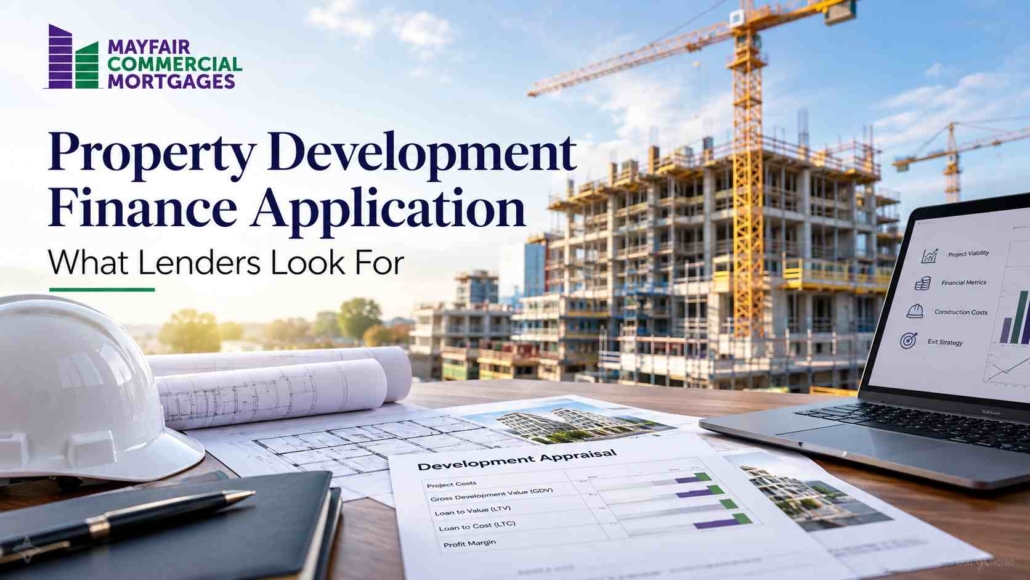
What Do Lenders Look for When Assessing a Property Development Finance Application?
People want to know what lenders look for when it comes to a property development finance application. Securing property development finance is fundamentally different from obtaining a standard residential or commercial mortgage. For example, while standard mortgages look backward at historic asset values and current borrower income, development finance looks forward. Lenders are underwriting a project that does not yet exist. They are taking a risk across planning, construction, market fluctuation, and execution.
Whether you are planning a ground-up residential build or a commercial-to-residential conversion, understanding how your proposal is evaluated helps you secure competitive rates. In this blog, we help you prepare for a property development finance loan. Our first advice is to work with a trustworthy mortgage broker like Mayfair Commercial Mortgages for top-quality work.
Property Development Finance Application: What do lenders look for
Here is an in-depth breakdown of the primary factors lenders assess when reviewing development finance eligibility.
Track Record & Team Capability
The applicant’s experience matters in the work they are trying to do. Lenders pay close attention to who is building just as much as what is being built. They love to see a proven history of similar projects completed on time and within budget. First-time developers can still secure funding, but it is a little trickier. As a result, they often face lower Loan-To-Value (LTV) limits or higher interest rates.
If the developer lacks direct build experience, underwriters scrutinize the rest of the professional team. They evaluate the qualifications and reputation of the main contractor along with architects, structural engineers, and project managers.
Planning Permission Status
Planning status directly determines loan structure and approval speed. If you have secured full, unappealable planning permission before you apply for the loan, the development finance application process goes a lot quicker for you. It shows them that you are dedicated to the project.
While bridging loans can fund land purchases with outline planning permission, senior construction lenders rarely release development drawdown facilities until full planning is granted.
Construction Appraisal & Budget Realism
A detailed, professional development appraisal is required by underwriters to assess the application. They assign an independent Monitoring Surveyor (MS) to review the build schedule and cost breakdown before funds are released.
Cost accuracy is a major development finance requirement. You cannot quote artificially low build estimates, as they are immediate red flags to your lender. Your cost should reflect the current market rates for materials and labor.
Lenders also expect a dedicated contingency line item. This is typically 5% to 10% of total build costs. It is there to absorb inflation or unforeseen structural issues.
In order to prevent funds from running out mid-build, lenders check that cash flow projections match actual construction progress. For this purpose, development funds are released in stages as construction milestones are completed.
Financial Metrics: LTV, LTC & Margin
Lenders evaluate the underlying financial viability of a project through key leverage and profitability ratios. These metrics determine how much debt the lender is willing to advance and how much equity the developer must contribute. It is also part of the development finance assessment.
| Financial Metric | Full Name / Description | Typical Lender Benchmark / Threshold | What Lender Look For |
| LT-GDV | Loan-to-Gross Development Value: The total loan amount relative to the estimated end value of the completed scheme. | 60% – 70% (Capped at ~75% for high leverage) | Ensures the total debt facility (including rolled-up interest and fees) leaves a sufficient equity buffer if end value declines. |
| LTC | Loan-to-Cost: The total loan amount relative to overall project costs (land, construction, professional fees, stamp duty). | 75% – 80% (Capped at ~85 – 90% for specialist stretch senior) | Measures how much capital the developer must invest. The remaining 20% – 25% must be funded via developer equity mezzanine debt. |
| Profit Margin | Developer’s Net Profit: The projected profit generated relative to total costs or GDV. | 15% – 20%+ on Gross Cost (or ~15% on GDV) | Acts as a crucial safety cushion to absorb cost overruns, material price inflation, or unexpected delays during construction. |
Conclusion
Building a strong relationship with a development lender comes down to transparent presentation and your readiness for the task. By thoroughly preparing your track record and aligning your financial metrics with lender benchmarks, you transform your property development finance application into a compelling opportunity. Working with Mayfair Commercial Mortgage can make the process easier for you.
Frequently Asked Questions
How much can I borrow?
You can borrow up to usually up to 60% to 70% of GDV or 75% to 80% of total project cost.
Do I need prior experience to get approved?
Not necessarily, but a lack of experience requires a highly qualified contractor and professional team.
What is a typical lender contingency requirement?
Lenders usually require a contingency budget of 5% to 10% of total build costs.
How is interest paid on development loans?
Interest is usually rolled up into the loan facility and repaid at the end of the project.
What minimum profit margin do lenders expect?
A target profit margin of 15% to 20% on total development costs is expected by lenders.


Leave a Reply
Want to join the discussion?Feel free to contribute!