
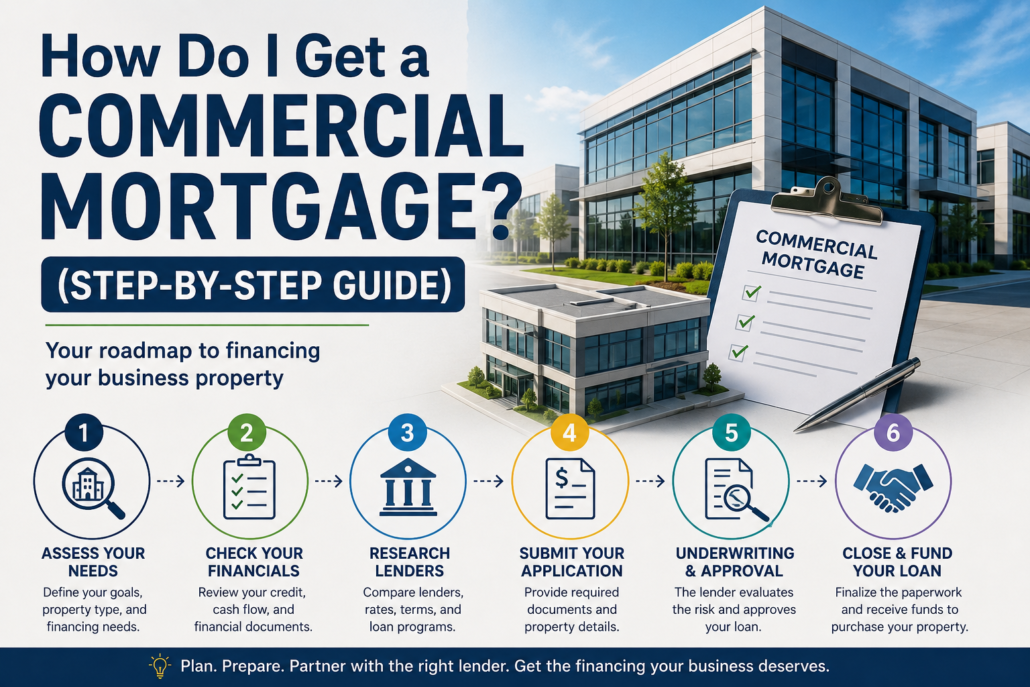
How Do I Get a Commercial Mortgage? (Step-by-Step Guide)
A commercial mortgage is a loan used to buy a property for business purposes. If you are asking how do I get a commercial mortgage loan, it is a straightforward process. You need to determine your budget, gather information and documentation, research lenders and apply. Wait for the underwriting, review the offer once you receive it and sign the commitment letter if the offer is acceptable. Choose from the fixed rate, variable rate, interest-only or partially amortizing types to suit your needs.
A Comprehensive Guide to Understanding the Commercial Mortgage Process
Whether you are a business owner looking to purchase a property or a real estate investor who wants to develop a property for future investment, commercial loans are an easy way to fund your projects. Borrowers typically feel excitement and stress when applying for a loan. The uncertainty and urgency create pressure that makes it difficult to execute proper planning within a tight timeline. If you are one of those who are juggling with the “how do I get a commercial mortgage loan”, we have summarized the process for you in the guide below.
| Did you know?
According to the Mortgage Bankers Association (MBA), commercial and multifamily mortgage loans were 66% higher in the second quarter of 2025, compared to a year earlier and increased 48% from the first quarter. |
Here is your step-by-step guide to understanding the process of obtaining a commercial loan.
Determine Your Budget and Needs
Take stock of your financial condition and how your business is performing. Determine your budget and the future expenditure to evaluate your overall expenses when considering the property size. Commercial loans usually require higher deposits as compared to home loans. The lenders analyze your business’s ability to repay loans based on the financial position, the projected income and the expected cash flow.
| Make sure you understand the associated costs such as the legal fees, valuation and arrangement fees and the exit fees. |
Gather information and Documentation
Lenders will require your business and personal financial information for the last two years, tax returns, bank statements of the last three months, credit reports, a solid business plan, legal entity documents and collateral details. They will access your business’s performance, stability and credit history. Strong profitability will improve your chances of approval and help you acquire a quick loan.
Research Lenders
Research the lenders to obtain the best interest rates. Compare the options and be prepared to negotiate deals that suit your requirements. The terms and conditions of a commercial mortgage are usually tailored according to your business’s stability and the market conditions.
| Important fact
Commercial mortgages can be acquired through banks, insurance companies, government agencies, mortgage brokers or conduit lenders. |
Choose Rates Carefully
Interest rates for commercial mortgages can be fixed or variable. Variable rates change with market conditions while fixed rates offer stability through monthly installments. The term usually ranges from 3 to 25 years. You may repay through monthly or quarterly installments or any timeframe according to your business output.
Submit Application
Submit your application along with all the required documentation encompassing personal and business details, business overview and plan, financial statement and collateral information, loan amount and the repayment method.
Wait for the Underwriting
Lenders will review your application on receipt of it via post or online. Your documents and details will be evaluated and verified. The underwriters will calculate the risks involved and assess your business’s ability to repay the loan in a given time frame.
| Fast Fact
The total US commercial mortgage debt rose to $4.88 trillion at the end of the second quarter of 2025. |
Review Your Offer
On passing all the checks, your application will be approved and you will be given an offer. Carefully review the offer and understand the terms, conditions and options. Accepting this offer will bind you to the long-term debt with associated risks, such as foreclosure.
Sign the Deal if Acceptible
After making sure you understand and agree to the terms and conditions of the commercial loan, sign the document. Your lawyers and agents will exchange contracts and you will be able to draw funds to boost your business growth.
Conclusion
Obtaining a commercial loan is a straightforward process but you will have to analyze your financial situation and do thorough research to avoid any pitfalls. By following the guidelines we have mentioned above, you will be able to secure a deal that suits your needs and have a smooth experience. A commercial loan is a strategic long-term investment that can provide a solid foundation to ensure your business growth and financial stability.
FAQs
What is the definition of a commercial mortgage?
A commercial mortgage is a loan secured through a commercial property and the proceeds are used to acquire or redevelop commercial property.
What is the right way to get the best rates in a commercial mortgage?
Obtain quotes from different lenders and compare their offers. To find the best deal, identify the competitive rates and negotiate deals to maximize your benefits.
What type of commercial properties are eligible for mortgages?
Common types include office buildings, retail spaces, industrial units and hotels, which are eligible for commercial mortgage.





Leave a Reply
Want to join the discussion?Feel free to contribute!